Susmita Lamichhane
Agriculture Student
Food shortages and escalating food prices are serious global issue, which social, political and economic implications. The factors that have created the food crisis are multiple and complex. Nepal is a country where the economy is dominated by agriculture. Farming and agriculture solely contribute 25.29% to the national GDP. Out of its total population, around 60% are engaged in agriculture. Farming in Nepal is mostly subsistence where agricultural crops and livestock are integrated. Even though both organic and inorganic practices of farming are widely followed in Nepal, inorganic farming is predominant. Agriculture is the mainstay of Nepal but still is not proficient enough to appease the daily consumption needs. The traditional, subsistence farming system in Nepal is barely sufficient to fulfill the burgeoning domestic consumption needs. The rapid population growth, and the ongoing climate change crisis have further aggravated the problem of food deficit in the country. The country heavily relies on neighboring borders to meet the growing demands of food for its increasing population. But, the world’s option for increasing food production is limited both by the supply of land and water.
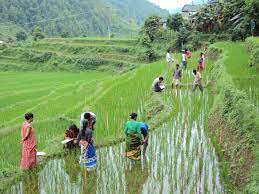
The ongoing system of farming practices in Nepal is deemed insufficient to explore the available resources in its optimum potential. Many cultivable lands in the country are still a virgin, and many indigenous crop varieties have remained unexplored in their wilderness that is rich in biodiversity. These possibilities embark great room for increasing agricultural productivity through the precision farming system if adopted the technology on a large scale within the country. To increase world food production sustainable manner, farmer will need to use the right technology at the right rate at right time and at right place. Amongst all of those, precision agriculture is the one. The national economy can be flustered and the environment can also be conserved using precision agriculture. It can address all agricultural and environmental issues. It is a technically sophisticated system and requires great technical knowledge for successful adoption and implementation.
Precision agriculture is a management system based on information and technology which analyses the spatial and temporal variability within the field and addresses them systematically for optimizing productivity, profitability, and environmental sustainability. It includes soil and spatial variation based on modern technologies and uses precise land leveling, seeding, fertilizer application, and irrigation to optimize crop production, and reduce environmental risk. The three main elements of precision agriculture are data and information, technology, and decision support systems. This system of management is known as ‘Site-specific management’ which makes use of technologies like global positioning system, global information system, remote sensors, yield monitors, guidance technology, variable-rate technology, hardware, and software. It is an emerging concept of agriculture that implies a precise application of inputs at the right place, at the right time, and in the right amount to minimize the production cost, to boost profitability and reduce risks. It is the management of field variability using ICT (Information, Computer, and Technology) Improving traditional agricultural practices by integration with modern technologies is only possible using precision agriculture.
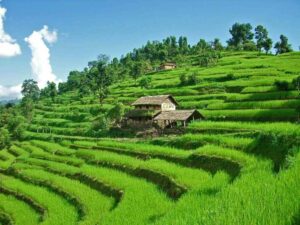
Nepal is a developing country and accomplishing a precision farming system is a way too far within a short period, but still, we can forward our journey towards revolutionizing agriculture and making the country self-sufficient in terms of food using the techniques of precision agriculture. Precision farming brings farmers, crops, and agriculture scientists together regardless of their geographical difference and facilitates agricultural information collection, evaluation, and spontaneous as well as instantaneous decision making. It is a holistic approach that helps the farmer to manage the spatial and temporal variability within the field for agriculture revolutionization by increasing the profitability, optimizing yield and quality, and reducing cost and is regarded as a paradigm shift in the management of spatial and temporal variability of soil and crop within the agricultural sector. Precision farming identifies the controllable yield limiting factors and determines variability by using modern technologies such as geographical information system (GPS), remote sensing (RS) and geographical positioning system (GPS). The ability to locate the precision position in the farm helps to create the map of spatial and temporal variability of the variables such as crop yield, soil moisture level, organic matter content, nitrogen level, pH, topography, etc. and implies site specific management practices that economically optimize the yield while maintaining the soil, water, plant, and
Tools for Precision Agriculture:
The basic tools that are used for precision agriculture are:
- Global Positioning System (GPS) which can provide knowledge where you are and where you are data (latitude, longitude and altitude) at any time and in any weather. It provides precise guidance for field operations or collect data on tillage applications, planting, weeds, insects and disease infestations, irrigations, etc. Increase farm and farm productive areas.
- Geographical Information System (GIS) which can import, export and process spatial and temporal geographically distributed data and store it. It provides data such as soil types, nutrient levels, etc. in layers and assign that information to the particular field location.
- Variable-rate Technologies (VRT) that has ability to apply the precise and variable number of inputs in the right place, at the right time according to the exact variation in the plant growth, soil type, and nutrient status.
- Remote sensing that is used to collect data from a distance to assess the health of soil and crops, and help to distinguish crop types, locate plants affected by pests and diseases, and monitor stress, soil, plant and drought conditions.
Similarly, Mapping, Proximat sensors, Automated steering system, Robots, Drones are tools used in precision agriculture. Today, the food production system is facing tremendous changes, and in the coming days, such changes will indeed increase. Due to the increase in population, the horizontal expansion of land is impossible. This situation requires the use of modern agricultural methods (such as precision agriculture) to increase food production on existing agricultural land. The economic and environmental benefits of agriculture can be improved through the precise application of inputs. The entire field can be managed based on site specific differences, rather than hypothetical averages that may not exist everywhere. In order to increase agricultural production and diversify the agricultural base, the government has focus on irrigation, the use of fertilizers and pesticides, and varieties till now.
The population of Nepal is proliferating at an alarming rate so is the demand for food whereas the food productivity is at menace due to climate change, population pressure, uneconomic landholdings, decreasing agricultural lands, etc. Population here is shifting towards the city area. The food production system faces formidable changes today which is genuine to increase in the upcoming days. Because of this, the fertile agricultural land in the city area is getting transformed into urbanized land. Beside it, the land in rural area remains uncultivated because of the labor deficient. Thus, to solve the problem of the hunger and suffice the human food needs, new technologies which can benefit with higher production and productivity need to be adopted. The food and Agriculture organization (FAO) of united nations has estimated that the total world’s demand for agricultural products will be 60%higher in 2030 AD than it is today. Future agriculture will be severely knowledge intensive, competitive, and market driven. The expansion of the land is not possible due to the increasing population. This scenario demands an increase in food production within the existing agricultural land using modern methods of farming such as precision agriculture. With Precision Agriculture, farming can be automated and the collection and analysis of field information are simplified as well as soil and environment quality can be conserved. It allows site-specific management decisions on small areas within larger fields and succors to optimize production efficiency and quality. Because of this, precision agriculture is one of the medium to solve the hunger and food security problem in Nepal.
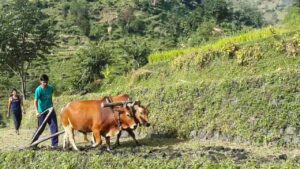
Nepal is still in infancy regarding he adoption of Precision Agriculture technology. However, Nepal has made some effort to blend ICT with agriculture. Currently, some private companies in Nepal are using precision agriculture technology because it requires a strong IT infrastructure and resources for monitoring. Project for Agriculture Commercialization (PACT) and Agriculture Management Information System (AMIS) under MOAD and several other organizations are working to increase the access of farmers to ICT. The Government of Province 5 has proposed the ‘Smart Agriculture Village Program’ with a budget amount of 360 million rupees which aims at increasing farmers’ income through commercialization of agriculture. Few agricultural applications like Smart Krishi, IFA Krishi, ICT for agriculture Yuba Krishi, Farm Nepal, Hamro Krishi are available in the play store which provides reliable information regarding the agricultural sector. Precision farming development requires huge technological advancement in Nepal.
Agriculture being the socio-economic backbone of the nation necessitates the implementation of Precision Agriculture to accelerate food productivity at a reduced cost, achieve food security, safety, and sustainability, and conserve the environment. It is still only a concept in Nepal and requires strategic assistance from both public as well as private sectors for successful adoption. Precision agriculture a way of research for revolutionizing agriculture and is a systematic implementation of the best management practices into a site-specific system. The concept of ‘doing the right thing, at the right time and the right place’ is an intuitive appeal. It is a technically sophisticated system of farming and requires technical manpower with the Knowhow of modern-day machines. Precision Agriculture can offer solutions to the agricultural and environmental issues of today. The major issues of conventional farming such as scarce input, change of weather patterns can be addressed using precision agriculture. However, farmers are most likely to adopt this system of farming only if it provides more or at least the same returns compared to the conventional methods of farming. The successful adoption depends on how well and how quickly the knowledge needed to guide the new technologies develops in Nepal. Assistance from the government and private sectors and training regarding the use of modern technological devices is a must for the development of precision farming in Nepal.
Writer/Author Susmita Lamichhane is a student studying agriculture. She has been writing various informational and informative articles on agriculture.


प्रतिक्रिया
सम्बन्धित खवर