Babita Pandey
Bsc.Ag:2nd semester:IAAS Paklihawa
Buckwheat belongs to group of foods commonly called pseudocereals. Pseudocereals are seeds that are consumed as cereal grains but don’t grow on grasses .It belongs to family polygonaceae. Despite it’s name, buckwheat is not related to wheat and is thus gluten-free. Two types of buckwheat, common buckwheat (Fagopyrum esculentum) and Tartary buckwheat (Fagopyrum tartaricum), are most widely grown for food. It is mostly consumed in the form of groats and flour which are used as material for porridge, noodles, bread, pancakes, spaghetti, and other food item. Buckwheat is mainly harvested in the northern hemisphere , especially in Russia, Kazakhstan, China, and central and Eastern Europe.
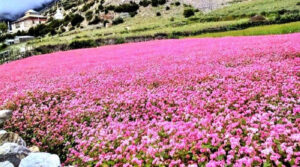
Health Benefits:-
Buckwheat is a highly nutritious whole grain that many people consider to superposed. One cup ,or 168 grams (of g) ,of roasted ,cooked buckwheat groats (hulled seeds) contains the following nutrients:
-5.68 g of protein
-1.04 g of fat
-33.5 g of carbohydrate
-4.5 g of fiber and many other nutrients in minor quantities.
Buckwheat also contain vitamins, including thiamine, riboflavin, niacin ,folate , vitamin K and vitamin B6. Minerals like Magnesium( lower risk of various chronic conditions, such as diabetes) Copper(may benefits heart health when eaten in small amounts), Manganese (essential for healthy metabolism, growth, development, and body’s antioxidant defenses), Iron(reduce oxygen carrying capacity of blood) and Phosphorus(role in growth and maintenance of body tissue). Due to this it has many health benefits.
1.As a whole grain , buckwheat could have benefits for heart health:
The American Heart Association (AHA) recommend that at least half the grains in a person’s diet should be whole grains. Whole grain foods contain nutrients that are important for heart health, including fiber and niacin. People who follow gluten-free diets may consume lower intake of whole grains, which means they miss out on the health benefits they provide. Including buckwheat into the diet as an alternative to whole grains that contain gluten can deliver these benefits. Buckwheat is a good source of fiber. According to the AHA , dietary fiber helps improve blood cholesterol levels, ,which in turn ,reduces the risk of heart disease, diabetes , stroke and obesity.
2.Weight management:
Buckwheat is high in protein. Research has found that high-protein foods are essential for weight management because they lead to greater satiety with fewer calories than other types of food. Including buckwheat in a healthful diet could lead to greater satiety and help with weight management.
3.Makes nail and hair stronger, supplying them with energy and power.
- Improve skin and slows down it’s ageing.
- Cleanse liver.
- Makes bones stronger.
- Boost memory. Buckwheat is known as the best food for brain.
- Improve blood sugar control:
Moderating the rise in blood sugar after meals is important for maintaining good health. As a good source of fiber, buckwheat has a low to medium GI. Some components of buckwheat seem to prevent or delay the digestion of table sugar.
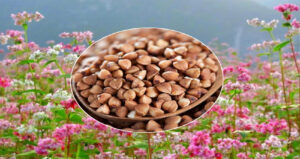
Cultivation Of Buckwheat in context of Nepal
In Nepal, buckwheat cultivation ranges from 60m in terai to 4500m above sea level. It is especially grown in hilly and mountain regions Rukum, Rolpa, Jajarkot, Dolpa, Kavre, Dolakha, Okhaldhunga, Mustang, Solukhumbu, and Taplejung districts regularly since immemorial. But recently it has been grown in some Terai districts like Chitwan, Jhapa, and Nawalparasi for commercial purposes especially for green vegetable which has very high demand due to rutin contents. Tartary buckwheat and sweet buckwheat are both cultivated in Nepal. Tartary or bitter buckwheat (Tite phapar) is grown in marginal land in higher altitudes.
Cultivation technique
Climatic Requirement:-
Requires cool and humid climate and is ready after 3-4 months. In himalayan region, harvesting is completed by first frost or snowfall. Tite phapar can tolerate much cold temperature than Mithe phapar. The best temperature and humidity for better germination , growth and development is 17-20°c and 70-80% respectively. It is rained crop and about 100 mm well distributed rainfall in it’s growing season is optimum. It cannot tolerate long drought and frost. High temperature, hot wind and drought during flowering is unfavourable for pollination and grain setting.
Soil and Field Preparation:-
Sandy loam soil or clayey loam soil are much preferable than other types of soil . However it can be cultivated in almost all types of soil. Similarly well fertilized acidic soil is good for higher production. Field is filled for 2-3 times and soil is made loose and cover the seed followed by planking to level the field, tillage is done 1 time and seed is down.
Seed and Sowing Time:-
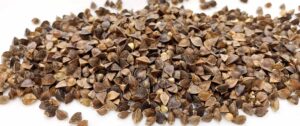
Seed rate is 60-70 kg/ha for Mithe phapar whereas 50-60 kg/ha for Tite phapar. Row to row 25cm and plant to plant 5cm is better spacing for buckwheat. Sow the buckwheat from Baisakh 15 to Jestha 15 in himalayan region, from Shrawan 1 to Bhadra in mid hill whereas Kartik -Mangsir in terai region. Generally broadcasting is done to show the seed but line sowing is better sowing is better than broadcasting method to obtain maximum yield with improved technology. Depth of sowing:- 4-5cm.
Manure and Fertilizer:-
Generally buckwheat has been grown without manure and fertilizer or cultivated in marginal land. For taking good yield 30:30:0 kg NPK/ha and 5-10 ton FYM or compost is necessary.
Irrigation:-
It is cultivated as rained crop in Nepal. If irrigation is available, irrigate after 20-25 days after germination and flowering or grain development.
Intercultural Operation:-
There is no weeding practice in buckwheat. When sown densely, it gives higher leafy production and dominates weed growth. If crop geometry is very low, in such condition one weeding within 20-25 days after sowing is better for better yields. Hoeing and earthing up operation are also not necessary. Thinning practice should be done 7-10 days after germination .
Crop Protection:-
There is no huge disease and pest and pest attack in buckwheat. Storage pest are huge problem if they are been stored with high moisture and in more pest attacking store room. So , storage is to be done in cemented house or making piles of field sacs in dry and cool area. White rust in some varieties initially affect in leaves , making them fall and then shift to flowers causing no grain formation or wrinkled grain formation reducing production. For management, apply Bordeaux mixture @ 10% in the field.
Harvesting, Threshing and Storage:-
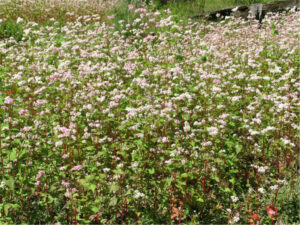
It never matured at the same time. So, it is harvested at highest maturity in the field i.e when 60-70% grain mature in plant. Generally, after 75-90 days after sowing which depends on climatic condition and management practice. Harvesting is done after dew dry in the morning to avoid shattering loss. Make heap for 2-3 days and dry them into sun to mature non matured grains. Then, dried mass should be threshed by using sticks or thresher on the threshing floor. After that, the grains should be cleaned and dried for 2-3 days , to make sure moisture content is 10-12% for storage. The average production of buckwheat is 540 kg/ha in Nepal but with improved management practices in Mustang district, 1.5 ton/ha yield has been obtained easily by the farmers. It can be stored at 5°c temperature and 40% relative humidity for 2 years easily.

Buckwheat has been occupying an important place in Nepalese agriculture system and contributing greatly in food supply especially remote places in Himalayas, though it is popularly considered as poor man’s crop, and under exploited and neglected crops in Nepal. And it can withstand the poor, infertile, and acidic soils, nutrients, moisture, and heat stress with wider adaptability. These unique characteristics of buckwheat show a great potential crop in future in food-deficit areas like high mountains which has high risk of climate change Impact.
Writer/Author Babita Pandey is a student studying agriculture. She has been writing various informational and informative articles on agriculture.


प्रतिक्रिया
सम्बन्धित खवर